
Maps of World War II 1939-1945
Maps of the Asia/Pacific Theatre 1941-45
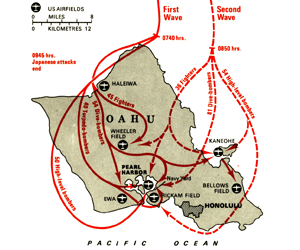
Japanese Approach to Pearl Harbor: December 7, 1941
The Imperial Japanese Navy fleet attacking Pearl Harbor launched a total of 423 aircraft in two waves against American military targets on the Hawaiian Island of Oahu.
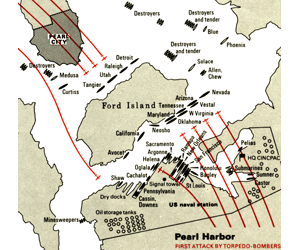
Attack on Pearl Harbor: December 7, 1941
Commander Fuchida led the first wave of torpedo bombers against the US Pacific Fleet ships at anchor in Pearl Harbor. Their first objective was to strike at the battleships
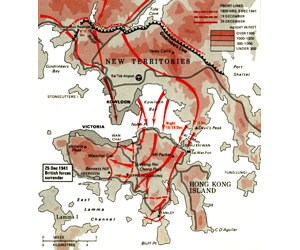
The Fall of Hong Kong: December 9 - 25, 1941
Japanese armed forces began the invasion of the New Territories of Hong Kong, from occupied China, on December 8th at 0800. Eliminating this Allied naval base was a priority. Most of the territory was captured by the evening of December 9th. The poorly equipped British and Commonwealth garrison forces surrendered on December 25th.
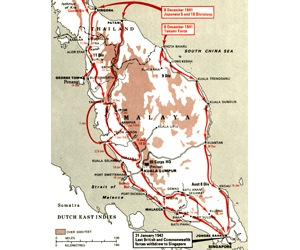
Invasion of Malaya: December 8, 1941 - January 31, 1942
The British possession of Malaya was a major source of rubber and tin. At its tip was the powerful naval base on the island of Singapore. Veteran Japanese troops of the 25th Army landed in the north and pushed through the jungle terrain. British armed forces, though nominally more numerous, were poorly equipped and inexperienced and were defeated by the end of January 1942.
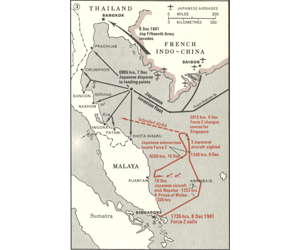
Sinking Force Z: December 8-10, 1941
The British battleships Prince of Wales and Repulse were sent to the Pacific by Churchill to provide a deterrent to Japanese aggression. Sailing from Singapore to attack the Japanese invasion forces in Malaya, they were discovered by a Japanese submarine and later sunk within two hours by an air strike involving about 90 planes.
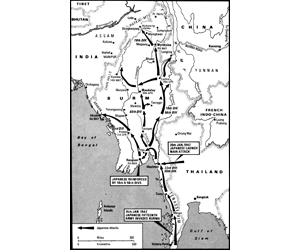
Invasion of Burma: January 15 - May 15, 1942
Japanese military attacks into Burma surprised the Allies and a rout ensued. The aggressive campaign inexorably pushed the British, American, Chinese and Burmese military units, based in Burma, into India and cut their land route into southern China.
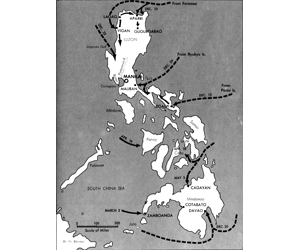
Invasion of the Philippines: December 10, 1941 - May 3, 1942
The American controlled Philippine islands represented a serious threat to Japanese expansive intentions in the Pacific and were therefore targeted for invasion. General MacArthur initially commanded the Allied forces. Japanese General Homma's diversionary landings in the north of the main island of Luzon failed to divide the defenders who nonetheless could not cope with the main landings at Lingayen Gulf. By the end of December most of the island was occupied.
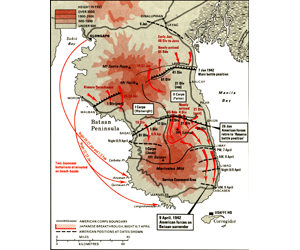
Conquest of Bataan: January 7 - April 9, 1942
By mid-January American and Filipino armed forces in the Philippines had retreated into the mountainous Bataan Peninsula of Luzon as well as holding the island of Corregidor immediately to the south, blocking Manila Bay. General Homma wrongly believed the defenders almost defeated and launched assaults that depleted his forces. A protracted period of trench warfare followed. The American command surrendered on April 9th.
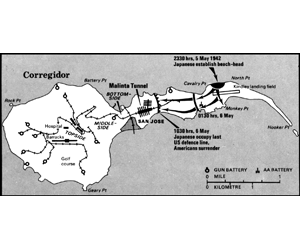
Conquest of Corregidor: May 5- 6, 1942
The last American outpost in the Philippines was the island of Corregidor. It was intensively bombarded and ultimately a Japanese force established a beachhead and quickly eliminated the remaining opposition. General Wainright surrendered on May 6th. Japanese expectations of a fifty day campaign in the Philippines turned into be a bloody six month effort.
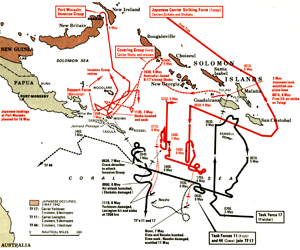
Battle of the Coral Sea: May 3-7, 1942
Japanese successes in their initial expansion led to plans to extend their intended defensive perimeter. Port Moresby was targeted for invasion and naval forces were concentrated for this objective. American code-breaking capabilities allowed US Admiral Nimitz to deploy a blocking force which engaged the Japanese in an inconclusive battle that led to the abandonment of this invasion.
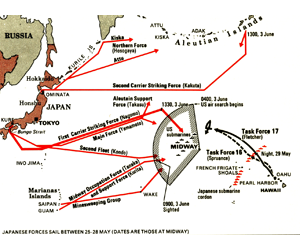
Approach to Midway: May 25 - June 3, 1942
Japanese recognition of the strategic importance of the US installations on Midway island led to the assembly of a large naval for force for the purpose of capturing the island. American intelligence again uncovered the plans for the pending assault and allowed the US Pacific Fleet to prepare for it.
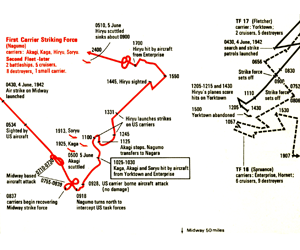
Battle of Midway: June 4-5, 1942
Japanese Admiral Yamamoto did not anticipate meeting significant American naval forces at Midway. A number of tactical errors ensued. A series of air strikes and counter strikes resulted in the sinking of the Japanese carriers Akagi, Kaga, Soryu and Hiryu and for the loss of the American carrier Yorktown. It was a decisive Japanese naval defeat.
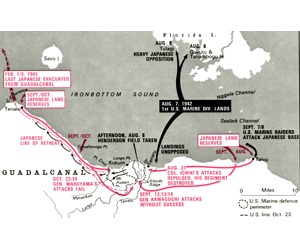
Battle of Guadalcanal: August 7, 1942 - February 9, 1943
Marines landed on Guadalcanal unopposed and quickly seized the Japanese built airfield. Several Japanese counterattacks were repulsed and a lengthy buildup, by both sides, ensued. A final Japanese attack in September failed. American armed forces went on the offensive in January. About 13,000 Japanese troops were secretly evacuated between February 6th and 9th, 1943.
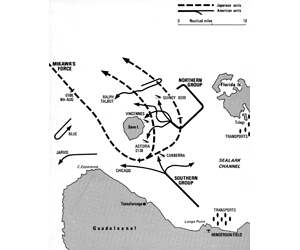
Battle of Savo Island: August 8-9, 1942
After providing support for the landings on Guadalcanal, US carriers were withdrawn from the immediate vicinity, leaving cruisers and transports. A Japanese cruiser squadron slipped past Savo Island on the night of August 8-9th and sunk four American cruisers and escaped unharmed.
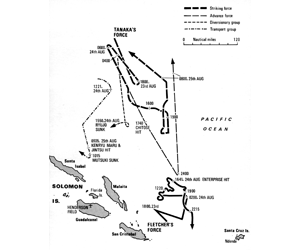
Battle of the Eastern Solomans: August 23, 1942
Both the Americans and Japanese sent powerful carrier forces into the Eastern Solomans to support of their efforts to supply their troops on Guadalcanal. Scouting efforts proved successful for both sides and air strikes were launched. However, neither side achieved any decisive results.
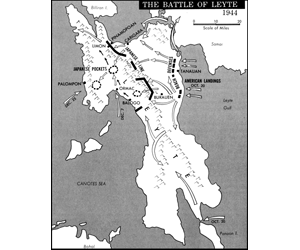
Battle of Leyte: October 20 - December 25, 1944
After debating the merits of different directions in the summer, the US chose to liberate the Philippines as its next strategic objective. The island of Leyte was the initial target. Japan viewed holding Leyte as a priority and General Yamashita was tasked with ensuring its defense. General MacArthur came ashore on the first day of the assault and issued his famous address to the Filipinos: "I have returned..." After two months of intensive battle, US armed forces had effectively completed the capture of the island.
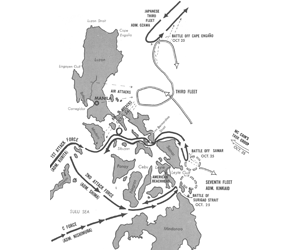
Battle for Leyte Gulf: October 23-26, 1944
One of the great naval battles of WWII ensued from the American landings on Leyte as the opponents sought to reinforce units already on Leyte. The US victory at sea ensured that American armed forces would overwhelm the Japanese army on Leyte. Japan assembled most of its remaining naval assets for the battle and aimed to destroy the US transports bringing military reinforcements to Leyte.
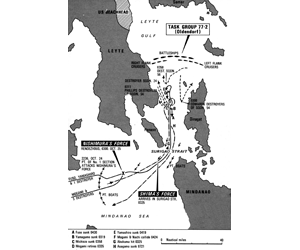
Battle of Surigao Strait: October 24-25, 1944
Two Japanese naval forces, under the command of Admirals Nishimura and Shima, respectively, attempted to pass through the Surigao Strait. An American force, including several battleships damaged at Pearl Harbor, blocked their route at the northern end. US PT Boats and destroyers attacked the Japanese forces, causing considerable damage, while the capital ships maintained their position and struck those that managed to pass through the screen. Both Japanese forces ultimately turned back after sustaining losses.
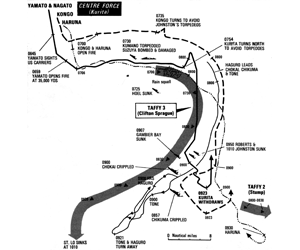
Battle Off Samar: October 25, 1944
Admiral Kurita's Center Force discovered Admiral Sprague's Task Force 3 consisting of escort carriers and destroyers. The American force was unprepared for naval combat and attempted to disengage. Kurita's force continued to close and inflict damage to the American ships but it disengaged before decisive results were achieved because Kurita feared the presence of more powerful American forces (which were in fact not there). Had Kurita pursued, he might have reached the US transports off Leyte. Among the first Kamikaze attacks took place during this battle.
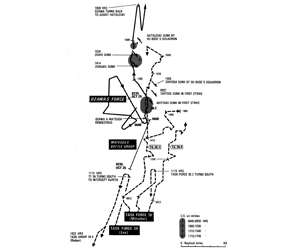
Battle of Cape Engano: October 25, 1944
Admiral Halsey led the main US fleet in the area to engage Ozawa's force approaching from the north. The Japanese intended for Ozawa to be a decoy and his approach did succeed in distracting the Americans. Substantial damage was inflicted on the Japanese force before Halsey turned back with most of the fleet to strike at Kurita. Some of Halsey's carriers continued to pursue Ozawa. Only two Japanese capital ships escaped destruction.
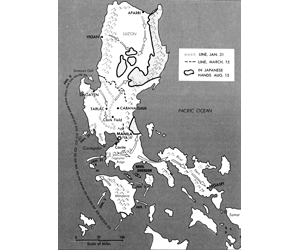
Reconquest of the Philippines: January 1 - August 15, 1945
After establishing a base of operations on Leyte, American armed forces built-up and proceeded to invade Mindoro against relatively light opposition and ultimately landed on Luzon on January 9th, 1945. Secondary landings were carried out to prevent the main Japanese forces from retreating to more defensible positions such as Bataan. By July 5th General MacArthur declared the Philippines liberated. However, some remote areas remained under Japanese control until the end of the war.
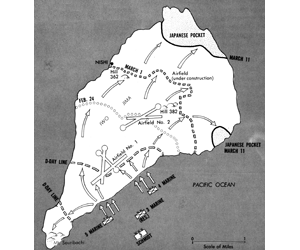
Battle of Iwo Jima: February 19 - March 11, 1945
Iwo Jima was the only Japanese base capable of interfering with American bombing operations against Japan. The entire island was heavily fortified and defended by about 21,700 troops determined to hold it. US Marines faced fanatical resistance once ashore and sustained heavy casualties. Total American losses numbered 17,200 wounded and 6000 dead. Only 200 Japanese troops were captured. Once cleared, the island was used as a fighter base for escorting bombers over Japan and as an emergency landing site for B-29 bombers operating from the Mariannas.
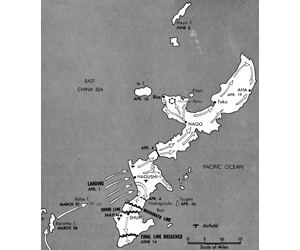
Okinawa Campaign: April 1 - June 14, 1945
Operation Iceberg, the US invasion of Okinawa, involved over 450,000 troops and 1200 transports in what was the largest naval operation mounted in the Pacific. About 130,000 Japanese troops defended the island from entrenched positions and they proved a formidable obstacle. Kamikaze attacks against the American naval forces also took a heavy toll. Almost all the Japanese defenders were killed, as well as about 42,000 of the 450,000 civilians on the island. Only 10,755 were taken prisoner. US casualties amounted to 12,500 killed and 35,500 wounded.
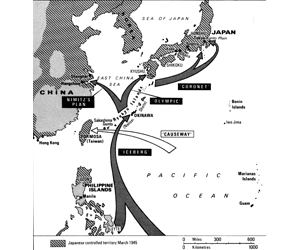
Allied Plans for 1945
US Army and Navy leaders differed on the strategic direction of the war against Japan. Admiral Nimitz preferred to forgo occupation of the Philippines in favor of an invasion of Formosa to be followed-up with landings on mainland China. General MacArthur, supported by General Marshal, wanted to occupy the Philippines, then land on Okinawa and follow up with a landing on Kyushu (the southernmost of the main Japanese home islands). After this, they intended to strike Honshu.
Copyright © 2018 Ralph Zuljan